A betrothal made and broken
When Francis Egerton returned from his Grand Tour he was not yet twenty and continued to follow the lifestyle of his titled contemporaries. He gambled at White’s, a fashionable London club, and on the turf too. Very interested in racing, he chose silk blue and silver as his colours and the newspapers were soon reporting how his horses were doing. He was a keen rider himself and not adverse to competing with associates who would give him a good run for his money. To this end he controlled his weight and lost so many pounds before one race a bet was evidently taken that the wind would blow him out of his saddle before he reached the finishing post! However, despite his love of gambling and the dice boards, he never seems to have been in any danger of being drawn into the kind of life of hedonistic excess lead by the Duke of Hamilton. Given his age, wealth and status it was perhaps inevitable that the question of marriage would soon be raised because, in 1750s, as it would be fifty years later, it was a truth universally acknowledged, that a single man in possession of a good fortune must be in want of a wife. In fact, despite his only being sixteen, rumours of a potential match had circulated even before he went on the Grand Tour, the Manchester Mercury reporting in September 1752 that We hear a Treaty of Marriage is on Foot between his Grace the Duke of Bridgewater and Miss Revel…. The same publication reprinted these words in June 1756 but how much substance they had is unclear. Maybe, fed up with waiting for the Duke to make his mind up, Miss Revel decided to switch her affections for by the end of 1758 she had married someone else.
Quite when and where the Duke of Bridgewater met the younger of the Gunning sisters is unclear, but it appears he soon became as enthralled as her late husband had been. A few years ago I visited the Valence House museum in Dagenham, which holds a collection of documents and paintings that once belonged to the Fanshawe family, into which the great-great-granddaughter of Maria Gunning had married. Remembering a small oval painting of Elizabeth that had been on display, I decided to try to take a second look at the end of 2020 because I thought it possible one clue to her exceptional attractiveness might have been captured by the brush strokes of a miniaturist. I was able, thanks to the assistance of museum staff, to make a closer inspection in the research room and was not disappointed. Although, according to a note on the back of the frame, the painting is a copy, it is probably an almost perfect reproduction. The artist is unknown but I did think more of Elizabeth’s ‘Je ne sais quoi’, which she must have had in spades, came through compared with Gavin Hamilton’s painting. Click the button on the left to see what you think and then read the comment by Osmund Bullock in the Art Detective link on the same page. Maybe best stick with the big painting after all!
To many in society the marriage between the Dowager Duchess and the Duke would have made perfect sense. She was now wealthy in her own right with the days of penury left far behind and he, although by no means one of the very richest members of the aristocracy, could certainly move easily in highest social circles. Moreover, as the Duke was apparently in robust health and neither Elizabeth’s good looks nor good nature had faded, there was probably little surprise when a proposal was made and accepted. Planning for the marriage began, an arrangement which, some may have slyly observed, was quite sedate and conventional compared with what had occurred on a St Valentines Day a few years previously. As the Duke’s father, Scroop, had had eleven children maybe some wondered if the forthcoming union could lead a greatly expanded Egerton family, but the speculators were to be proved mistaken. There was not to be even one child, for the engagement was broken not so long after it had been announced.
Given the plausible contention that, as a result of the separation, the whole development of the industrial revolution in England was reset, it is not surprising the cause of the broken engagement became a matter of interest to historians. As the general consensus is that it was the Duke who was jilted, perhaps we must look to Elizabeth’s changing attitude for clues to the upset.
One suggestion is that the fiancée thought the fiancé might not be long lived due to consumption, the term commonly used to describe what we now know as tuberculosis. This disease certainly seems to have had a devastating effect on the Duke’s male siblings. Scroop had been married twice, first to Elizabeth Churchill, daughter of the Duke of Marlborough, by whom he had three children, two boys and a girl. Only the girl survived to adulthood. After Elizabeth died Scroop married a second time and by this marriage there were eight children, five boys and three girls. Except for Francis, all the boys bar one died when they were young and John, the only one who survived into his third decade, passed away when he was 21. The scourge of the males was, evidently, the greatly feared wasting disease. Having already lost one husband perhaps Elizabeth had a change of heart when she mulled over the possibility that Francis, unlike his sisters, might be susceptible to the illness that would ‘consume’ him. When she met him he was, after all, about the same age as John when he died.
However, there may have been a second contributory factor to the broken engagement. Perhaps Elizabeth still wanted to marry, but had decided another suitor, mature and more dashing, would make a more suitable spouse and this made her more receptive to the attentions of Colonel John Campbell, a rising military star who had seen action against Bonnie Prince Charlie’s Jacobites. Campbell was clearly destined for a much higher rank, was in line to become the 5th Duke of Argyll on the death of his father and at 36 was much older than Francis. He almost certainly exuded a worldliness that the younger aristocrat would have found hard to match and doubtless used it to full advantage. After all, all’s fair in love and war.
The Victorian Self-Help advocate Samuel Smiles suggested a further cause for the couple going their separate ways. This pivoted on the behaviour of Maria, who had married the 6th Earl of Coventry. The marriage was not happy but when gossip reached the Duke of Bridgewater that his potential sister-in-law was having an affair with another aristocrat (Smiles refers to the rumours ‘reflecting on the character of Lady Coventry’) he decided to insist Elizabeth distance herself from her sibling. In the circumstances it is surely understandable that she refused, if only out of loyalty to someone with whom she had dramatically clambered to the top of the social pyramid, but she may well have had another reason not to abandon her sister. Maria was more garrulous than Elizabeth but maintained her arresting good looks until they were destroyed by contemporary cosmetics. Fashion of the time dictated woman in society should have a white face set off with red rouged cheeks but, unfortunately, the means to achieve this was through the application of lead based make up. This caused skin problems, which were concealed by further applications of the noxious substance. Is it possible Elizabeth had noticed that her sister was using an increased amount of cosmetic and that it was affecting her health? If so she had good reason to be concerned.
It is hard to tell how strong the Duke’s determination to carry his point was, but, according to Smiles, it was Francis himself who broke off the engagement when Elizabeth refused his request to end her relationship with Maria. This may have been the case, but the Duke’s subsequent behaviour indicates he felt the split very keenly, particularly after his ex-fiancée accepted a proposal of marriage from the Colonel with, perhaps, unseemly alacrity.
Elizabeth seems to have had few, if any, regrets about ending her engagement to the Duke of Bridgewater and looked forward to her marriage to Colonel Campbell. Unfortunately, Maria was not to share in her good fortune. She was to die in 1760, almost certainly as a result of the effects of the cosmetics she had been using. But Elizabeth’s star continued to rise. Always a royal favourite, she was made Lady of the Bedchamber to Queen Charlotte in 1761, a post she held until 1784. Becoming Duchess of Argyll when her husband became the 5th Duke of Argyll on the death of his father in 1770 Elizabeth was later made Baroness Hamilton of Hameldon in her own right by George the Third. She had five more children, three of whom survived to adulthood. Four of her children, two from each of her marriages, became Dukes and her daughter, Lady Charlotte Campbell, writing under a nom de plume, became quite a popular novelist.
The Canal Age begins
In January 1759, Horace Walpole, referring to the betrothal between Elizabeth and Colonel Campbell, commented ….everybody likes it but the Duke of Bridgewater… and this time there were no missteps on the way to the altar. In February the Dowager Duchess became what we might call a potential Double Duchess when she married Colonel Campbell but in the following month the Duke of Bridgewater threw a great party in London, which might be seen as a defiant gesture showing he would strike off in a new direction rather than mope and fret over failed matrimonial plans. The new path was set out in an Act of Parliament, which had by this time been given its third reading, authorising the construction of a canal. The Bridgewater Canal, as the new link was to be called, was to be markedly different to previous ‘navigations’, which tended to follow the courses of rivers, or be improvements on the way a river itself could be used, a good example being the Lee Navigation. After the ending of his engagement the Duke applied most of his energies to this and similar projects rather than to finding a new wife.
When a boy it is quite possible the Duke observed the coming and goings on a busy wharf at Chertsey, which was part of the Egerton family property portfolio. However, it was in Lancashire that he was to develop his interests in water transport and in the first instance this was linked to the movement of coal from mines on his estate around Worsley, which is about 6 miles, as the crow flies, from Manchester. Unfortunately, there were major problems in winning the fuel at Worsley caused by permeable sandstone the coal seams. Attempts to overcome this hindrance led to the creation of soughs, which were underground drainage tunnels, dug into a hill in which the coal lay. It appears that John Gilbert, the Duke’s agent in charge of the land and mines, was responsible for an initial idea that would both utilise drainage water and create a method of transporting coal to market with as little handling as possible. James Brindley, an experienced engineer (a term that could include water management, surveying and bridge construction) was at that time working for the Duke’s brother in law and was recruited to help realise the project. When the triumvirate reviewed the practicality of the line set out in the 1759 Act it was decided to make a change. A revised plan, which formed the basis of a second Act passed in the following year, was the one that was followed. Under this water from new soughs would be fed into a subterranean canal on which coal could be loaded directly into boats. From there it would be taken all the way to the wharves of Manchester, crossing the River Irwell on an aqueduct at Barton.
A boat-carrying aqueduct was to be an innovative feature in England’s waterway network and responsibility for construction was placed in the hands of Brindley, who had unusual methods of explaining complicated technical issues to the layman. This was shown when he used his pocket knife to carve up a cheese as he explained to a parliamentary committee how sound the idea of the aqueduct was! Work began on the canal in 1760 and the first boatloads of coal ran into Manchester in July 1761. Sceptics who said the aqueduct would not hold water were confounded and it soon attracted many visitors. Jean-Jacques Rousseau was one and he was suitably impressed. The soughs were also opened for viewing after the Duke put passenger boats on the canal and allowed them into the subterranean section.
Despite the success of the Worsley to Manchester link the Duke’s debts were gradually mounting as he had funded all the canal works himself, much of it on borrowed money supported by bonds paying a good rate of interest. Nonetheless, he cut his personal expenditure and continued with plans to extend the canal some distance beyond Manchester to Runcorn. An item in the Chester Courant in November 1761 indicated a meeting would be held in Northwich for those who might be interested in or affected by this proposal. The Duke hoped such an extension would eventually lead to an increase in trade between Liverpool and Manchester, which could be very profitable for his canal through toll revenue. It was clear it would take a lot longer to build than two years and the Duke doubtless anticipated he would meet the kind opposition from those affected by his project that was to become quite common in the expansion of the canal network. However, he was always a very determined entrepreneur with both business acumen and an ability to organise parliamentary support. His prestige also kept on rising. Great personal support was found in Manchester, which is not surprising given that the price of coal fell by 50% as a result of his drive and ambition.

When London Became An Island

_by_Thomas_Gainsborough-1.jpg)
John Campbell
5th Duke of Argyll
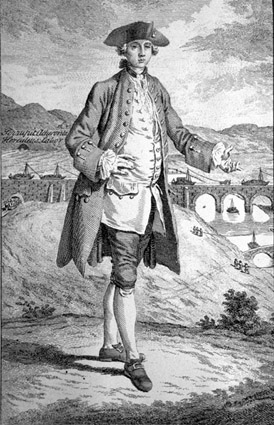
The Duke stands before the Barton Aqueduct