An article about the King of the Narrow Seas fails to sink him
It might be too much to say the Bridgewater Canal was to the 1760s what the Gunning sisters had been to the 50s, but it was certainly a ‘must see’ venue. An anonymous letter published in the Oxford Journal in 1766 was written to someone who had left Manchester ten years previously and shows the enthusiasm the canal generated. The letter begins;
As it is ten Years since you left us I think you would be entertained if you made us a Visit; for this Place is wonderfully altered. We have long called it Little London, and the second Place in the Kingdom, though neither City nor Corporation, but now it is become Sort of Maritime Town, Dutch Sea Port; for the Duke of Bridgewater’s Canal, comes Water enough to make a great Navigation, upon which have Coal Barges, Timber Barges, and Corn Barges, as you have at London……
The enthusiast goes on to report on what appears to have been a pleasure boat on its way to Worsley saying;
They were towed Horses towards Worsley Hall, and had a Band of Musick in the Dract-Skoat, or Barge.
After describing the positive changes that had taken place in Manchester and suggesting that a new navigation might be built to Stockport the letter ends by what the result might be for the Duke;
…..our great Man will then have an immense Income, and we already call him King of the Narrow Seas.”
Such enthusiasm helped the Duke to become very influential. As time went by many canals were projected elsewhere in the country and it became clear that if the ‘King of the Narrow Seas’ didn’t approve, a parliamentary Bill would almost certainly not pass. When it was suggested that a canal be built to link the rivers Trent and Mersey the Duke seemed to be somewhat apprehensive, but after meeting Josiah Wedgwood he offered his support and the Trent and Mersey Act subsequently gained the Royal Assent. The Duke’s involvement in any project did not mean, of course, that it would ever be easy to buy all the land needed, as was eventually seen in the disputes between the Regents Canal Company and Counsellor Agar. Such disagreement could generate considerable bitterness and was apparent even on the line of the Duke of Bridgewater’s Canal.
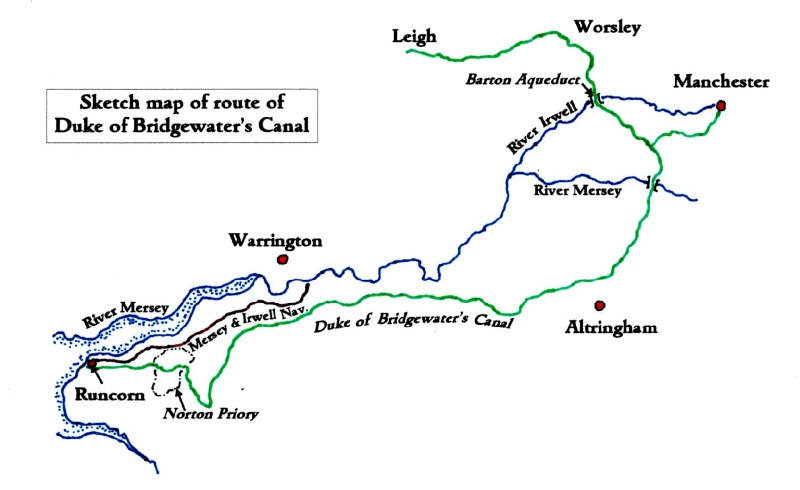
As the canal was dug to Runcorn, the Duke met stiff opposition from the owner of an estate called Norton Priory. Sir Richard Brooke, who did not want the canal passing through his land, refused to negotiate a sale for years and as the obstruction continued tempers rose. Discussions dragged on and on until, in October 1775, John Gilbert was rebuffed on making what he said was the Duke’s final offer for the last parcel of land needed to complete the canal. Very curiously it was in the same month that what might have been just a scurrilous, fabricated story about the Duke appeared in a periodical published in London.
According to the Earl of Ellesmere, after his broken engagement, the Duke is said never to have spoken to another woman in the language of gallantry. He certainly never married and yet there is a question mark over his relationship with someone who, if the article, is to be believed, was kept hidden away on one of his estates.
A number of magazines, of varying quality, circulated in England in the late C18th. The Town and Country magazine or Universal Repository of Knowledge, Instruction and Entertainment has sometimes been referred to as a scandal sheet and, although it was essentially a compendium of miscellany, there is no doubt that dubious stories, carried as ‘Histories of the Tête-à-Tête’, were clearly aimed at boosting circulation in a quite competitive market. These ‘histories’ were often targeted at members of the aristocracy and in October 1775 it was the Duke of Bridgewater who found himself in the sights.
Readers who sat by their fires and relaxed to read the letterpress as a break from the wet and dreary autumn found from the contents page that it was Embellished and illustrated with the following Engravings. 1 A good likeness to the D___ of B______r 2 An excellent Portrait of the demure Miss L__y. and these illustrations were printed a few pages further on (click here). Then followed three pages of description of the D___ of B_____r (who everyone would have understood to be the Duke of Bridgewater) and of his relationship with a young woman who had grown up on one of his estates and whom he knew. Evidently, having read romantic plays and novels and seen Juliet performed when on a visit to London Miss L___y decided she wanted to play the romantic heroine herself and eloped with a group of travelling players, a way of earning a living that proved far from secure. One night, when the Duke was passing through Salisbury, he saw a performance of The Recruiting Officer and recognised the person playing one of the main characters. He consequently invited ‘Sylvia’ to eat with him after the show and having perceived her eat very hearty, or rather voraciously, the Duke heard of the hardships and sufferings of life on the road. There and then he made an offer that could not be refused and early the following morning the pair set off in a post-chaise leaving world of theatre behind. Subsequently the ex-actress, who quickly threw off her tinselled finery, was installed on a small farm where she was to spend her time working and reading, dressed only in the quaker style to show she had reformed. The Duke visited her frequently but always did so incog and with such decency and decorum, that few people in the neighbourhood suspect an alliance of the amorous between them.
If these events did occur is impossible to say, but the implication of the article was that the relationship was continuing at the time of publication. This would undermine the assertion that the Duke never spoke to another woman in the language of gallantry after the end of his engagement. Why any magazine would run such a story at this particular time is a puzzle although as, by 1775, he was one of the most famous and well regarded aristocrats of his generation, he was an easy target for scandal mongers out to ruin a reputation and make money as they did so. Could a fabricated story have been a ‘plant’ by one of Sir Richard’s supporters or someone else the Duke had upset? He had, after all, trodden on plenty of toes including those of other landowners and monopolists of ‘Old Navigations’. Well, possibly, but maybe there was no truth in the suggestion of an alliance of the amorous whatsoever, for the Town and Country magazine sometimes did run fiction masquerading as truth. In fact, in the same edition, readers were warned about those spreading misinformation by King George the Third himself, although the sovereign was complaining about truculent residents of the 13 colonies rather than those generating ‘fake news’ about clandestine relationships in London.
It would be interesting to know what impact, if any, the Tête-à-Tête story about himself and Miss L---y had on the Duke but it did not undermine his drive to complete the extension. He had already built both a house at Runcorn, which he used when supervising on-going work, and a flight of ten locks to take canal traffic down to the Mersey, with a river lock constructed so boats could enter or leave on any tide. All that was missing was the section across the Norton Priory estate. If anything, any embarrassment suffered because of the magazine article probably intensified the Duke’s determination to resolve the matter as soon as possible, for he and Gilbert travelled to London before Christmas to marshal parliamentary support. Sir Richard would have found it very difficult to resist this kind of pressure and so accepted the need for further negotiation. After the issue was finally resolved this part of the canal was completed and opened in March 1776. A further extension, from Worsley to Leigh, was constructed in the 1790s.
The forward thinking Duke had seen how important a waterway link between Liverpool and Manchester could be. Even if this meant using both the Mersey and the canal it was a great improvement on the previous transport options that included pack-horses and carts. When the Manchester Ship Canal was opened in the 1880s ocean going vessels could sail right up to Manchester so really making it a sort of Maritime Town. At about the same time Ford Maddox Brown was commissioned to paint twelve murals in the Great Hall of Manchester Town Hall. One of these paintings shows the opening day of the Bridgewater Canal. The Duke stands watching as a barge named Young Duke, passes by.
It was not until the late 1780s that all the projects in which the Duke involved himself began to turn a profit and he could begin to pay down his accumulated debts. By that time he had long ceased to be the slim young man who had sought the hand of the Dowager Duchess and as he grew older was regarded as rather eccentric aristocrat with old fashioned clothes, a problem with gout, a substantial waist measurement and quite a broad Lancashire accent. But he remained sharp and open to new ideas. Experiments with a steam boat, based on a hull constructed at Worsley and an engine manufactured locally to the design of Robert Fulton, were undertaken right at the end of the C18th and just after the turn of the century the Duke ordered 8 boats of the ‘Charlotte Dundas’ type although these were cancelled on his death in 1803.
Despite the importance of Worsley in his life the Duke was buried at Ashridge, near Berkhampsted. In the 1760s he had built a new house at Worsley, usually known as the Brick Hall, which was occupied by John Gilbert and his wife, but although the Duke stayed there when visiting the area the administrative centre of the Egerton estate remained at Ashridge Hall, a residence which had been owned by the family since 1604. When in London the Duke usually stayed at Bridgewater House, which is where he died, but he must have had other regular, if temporary, places to stay when visiting properties in other parts of the country. He also had, of course, his house at Runcorn.
The Brick Hall was demolished by the Earl of Ellesmere who, under the terms of the Duke’s will, eventually inherited the estate. It was replaced by the New Hall, constructed nearby in the 1840s. This became derelict in the C20th and Bridgewater Garden has been constructed on the site.
In a time when social relationships could be very hard the Duke had a good reputation for the way he treated the poor and those who worked for him. He gave instructions, for example, that in the event of a shortage of Worsley coal in Manchester, the poor should be given priority of what was available. On his death he bequeathed a year’s salary to all who worked for him for a year and two year’s salary to those who had worked for him for two years or more. His memory passed into local legend and it was said that at midnight, once a year, a coach, drawn by six black horses and in which the Duke was travelling, would go charging through a local village. I think phantom black horses feature quite widely in English folk lore, the ghost of Bishop Bonner, for example, was evidently seen in a coach drawn by black horses in the area through which the Regents Canal was cut. So, perhaps visitors to the Bridgewater Garden may be forgiven for forgetting coaches and coal black horses and just imagine the Duke, slowly sailing by on his canal to the jolly sounds of a band playing mid-C18th Musick.
Click here to hear some now.
Click here to go back to page 5 of the Kings Cross to Bethnal Green section.
And if you would like to find out more about the new garden (with its kitchen garden walls!) Click here.

When London Became An Island
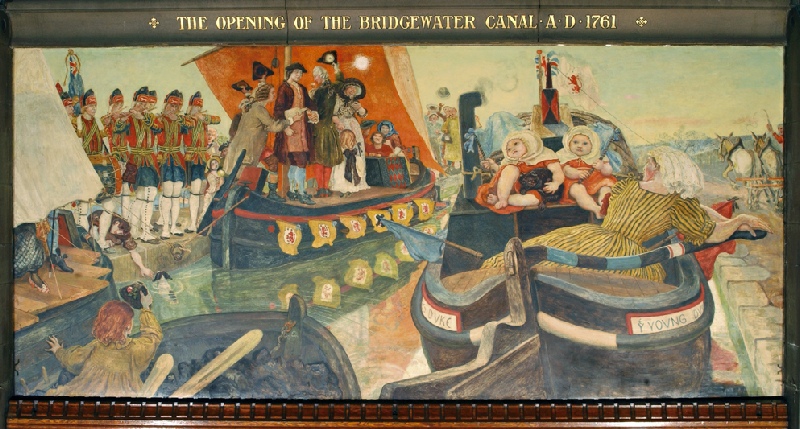
The opening day of the Bridgewater Canal
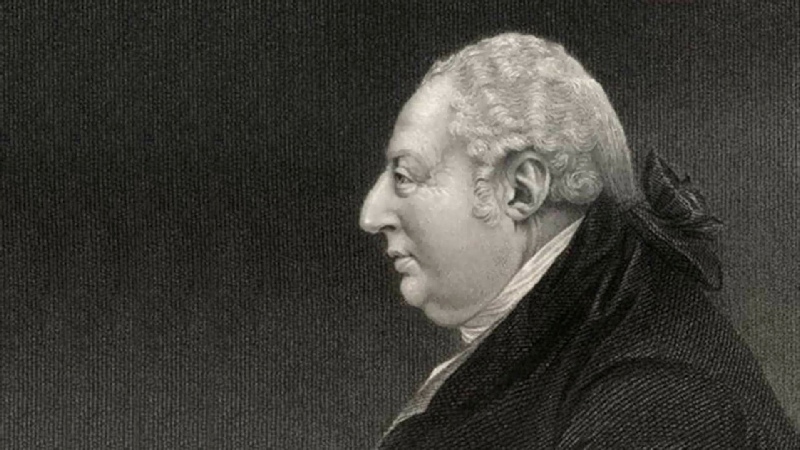
An older Duke