When London Became An Island
Soochong, Shoguns and the Saracen’s surveys
4th Sept.
Weighed at daylight and proceeded towards Nangasaki with a light air from the Northward and anchored in the Outer Harbour at 12 o’clock.
When about six miles from the North Cavallo we were boarded by a government boat, one of the crew of which having handed up a paper she immediately shoved off and pulled towards the shore.
This paper contained a general order from the Governor of Nangasaki to all vessels arriving off that port to anchor off the outer or North Cavallo and await further instructions, adding that disobedience of these orders would occasion ‘serious consequences’.
On nearing the Cavallo I observed two European vessels at anchor in the harbour (which afterwards turned out to be H.M.S. Barracouta and the hired steamer Tartar) and being anxious to obtain sights as soon as possible, I disregarded the frequent invitations of the guard boats to anchor outside, ran in and anchored near the Barracouta in 15 fms with Papenberg Island bearing W.N.W. about half a mile to the south.
We were immediately boarded by several boats containing the officials of the port, who all seemed very anxious to ask questions but finding that we did not speak Dutch they were sorely puzzled how to proceed; as we had no particular interest in enlightening them, it did not give us much concern when at last they suddenly came down from their high position and laughing heartily called one of their party out of a boat lying alongside and tried to sub up some English. Seeing them in good humour I invited as many as my cabin would contain to take cherry brandy and with the assistance of a vocabulary succeeded in furnishing them with the information they required. After delivering the subjoined document and taking a list of refreshments required they departed very well pleased.
All vessels ought to anchor outside of the cavallo and there wait the advice of the government.
Salutes shall not be fired.
It is not permitted to go on shore though there are but islets
It is forbidden to take surveys of the coast, no boats are allowed to go to and fro.
When it is desired to speak it shall be communicates to the guard officers barks.
Boats passing by shall not be approached or accosted without consent (of the authorities?)
No object ought to be offered, neither accepted nor bought, without consent (of the authorities?)
The foregoing Articles are the law of this Port, in consequence the commander and high officers ought to comprehend this and bring it to the knowledge of the ships crews in order that this law shall be attended too.
11 Year of Ansei
The Governor of Nangasaki.
The Barracouta and the Tartar had remained at the Cavallo until permission was obtained from the Governor for them to enter the harbour and we afterwards ascertained that the Admiral had been served the same way on his visit last year. Had I obeyed the Governors order I should have lost the next days sights and as it came on to rain and blow very hard any positions obtained on the coast between Hakodadi and this would have lost much of their value, indeed, I might probably have had to slip and put to sea for the anchorage at the Cavallo is much exposed and the water very deep.
On looking around from our anchorage we observed three Dutch vessels (one with an Admiral’s flag) anchored in the inner harbour, and a line of Japanese guard boats drawn up across its entrance to prevent all communication between us and them. Guard boats were also drawn up across the entrance to all the creeks in addition to those placed near our vessels. An island about a cable length in diameter appropriated to the use of our squadron last year was also strongly guarded, and the government boats rowed around the squadron all day and night.
We succeeded in purchasing a small quantity of stock at the following prices.
There is a blank space here in the Remarks Book
All our demands for stock were written in English and the bills accompanying the supplies when brought on board were expressed in the same language they appeared to have been translated by a Dutchman from the word ship being spelt “schip”.
On one occasion we were delighted with the comprador promising to bring us off a bullock if we wished to have one; there was no mistake about the man’s meaning although he spoke English imperfectly; accordingly a bullock was demanded and after the lapse of two days we were beginning to feel some surprise at not receiving it according to promise when the following extraordinary document was sent to me by Captain Stirling of H.M.S. Barracouta.
By the third schip a cow is required. In our country cattle are used for agriculture or transportation of goods, at Nangasaki cattle is commanded and to be had only from distant places therefore it cannot be reckoned as victuals.
An interpreter has told you that no cattle of 100 catties are to be had but will of 200 catties. We think it is bad translated it has been the intention to state that cowes are not to be had here.
The pig is no common article of food among the Japanese but it is bred by the compradors who are appointed for the Dutchmen and the Chinese who have their residence at Nagasaki.
However they are not in great number therefore pigs are bred in small numbers. Since the tenth of last month some pigs were sent off to your schips, in consequence the number is diminished.
On this account we will try our best to look for pigs in the villages, it is however impossible to send them every day. Therefore the necessary arrangements are required alternatively every third or fourth day by every schip.
Fowls and ducks are likewise no common article of food among the Japanese therefore we shall perhaps not comply with your demand in case they are not to be had.
It is impossible to procure on the next day the required articles that are to be had only from distant places.
If something is asked for by the different members of the crew it gives way to confusion.
Therefore the Commanders of every schip please to send a final list of the articles wanted by the Officers or others and such contained in a little book that ought to be handed over on the very moment that the articles are delivered by the Japanese and with which every article ought to be confronted whilst the Commander please to ascertain by the means that all is duly received.
All that is required ought to be ordered the day before at 10 o’clock otherwise it cannot be procured on the next day. Accordingly a signal flag ought to be hoisted giving to know that something is required after which the Japanese will go immediately to the ship to receive the note of the provisions.
The articles however which are not to be had will not be found amongst those supplied.
Mr Frederick H. Stirling Esq. Commander of H.B.M. Ship Barracouta is hereby required to communicate the contents of the annexed papers to the Commanders of the other Ships.
The authority or signature was affixed to the document and it was not dated – it was evidently written with the intention of making the “third ship” as they styled the Saracen (from her arriving after the Barracouta, and Tartar) and of rendering their surveillance of us more complete by restricting our demands for supplies to one particular channel, if such was their pleasure they must have been much gratified at a general order issued the next day by Capt. O’Callaghan of H.M.S. Encounter, forbidding all communication whatever with the Japanese excepting through his ship, and one particular time which was fixed for 10 a.m.
The Japanese had been thoughtful enough to build a couple of small houses for the use of the officers on our island since the Admirals visit last year, so as the islet was too small and hilly to walk about for exercise they could sit and read which was a little relief to them after their long but unnecessary cruise to the Northward. My visits to the island were confined to the times necessary for observations.
Short technical description of observations here.
As the Japanese Port orders entirely prohibited surveys being made and as these orders were backed by a very stringent one from the Admiral, I did not attempt anything of the sort nor indeed would it have been worth the time or risk of making a “secret” survey of the Port whilst we possess Von Siebolds, which from appearances I think very correct so far as it goes and quite equal to the wants of all the commerce we are likely to have here at present.
The Admiral not arriving at the time expected we left Nagaski on the morning of the 20th for a short cruise in the strait inside the Gotto Islands. Just as we cleared the Port the Japanese batteries commenced firing signal guns, and shortly after H.M.S. Sybille hove into sight standing in for the harbour. The wind being very light we did not make much progress and at sunset anchored in 25 fms off Jemie-sima with the centre of the islands bearing N.E. about 5 miles.
Early in the following morning we weighed with the intention of proceeding further to the Westward but the wind being very light I changed my plan and hauled up for Jemie-sima hoping to land and take advantage of brilliant sun for observations. By 7 o’clock we succeeded in getting within three miles of it, where we anchored and I left with the cutter and gig for the south point of the island. As I expected the Japanese did not ‘welcome’ us on shore, but they did not show the least symptom of hostility after we had fairly gained the beach, and by the time the Tent was set up and the Observations commenced we were on the most intimate terms. I obtained a complete series of observations, and returned on board at sunset.
Just before noon a number of soldiers commenced setting up a large Tent close to ours and they had just finished as two chiefs arrived attended by a large retinue. They were dressed in a very picturesque costume, the principal article being a kind of heavy jacket without sleeves, richly embroidered with several colours in front of which yellow predominated in one and red the other. After taking their seats under the Tent they dispatched an officer to me with a letter written in Japanese. At this time I was in the middle of my noon observations for latitude, and of course could not be interrupted so the letter was left with our sentry in front of the Tent. After finishing my observations I retired to our Tent when another messenger was sent to me who intimated by signs that I must visit the Mandarins, this however I refused to do but compromised matters by inviting them to visit me, which invitation somewhat to my surprise was immediately accepted by them. They were very deferential and polite in their bearing and evinced much gratitude for the trifling presents made to them, finding them so friendly disposed I accepted a second invitation to adjourn to their Tent with which they appeared much pleased and forthwith a collation was served up in Japanese style. The Saki and pipes having gone around my boats crew were entertained in a similar manner by the Chief’s orders and good humour prevailed. Our clothes now underwent a strict examination they particularly admired the flannel and cloth articles and inspected each article with much minuteness. After p.m. sights I ascended a hill in the neighbourhood and obtained a round of angles then returning to the beach struck the Tent and embarked, after taking a friendly farewell of our hospitable entertainers.
The punctilious respect paid us by these people was remarkable. It may be easily imagined that ‘surveying costume’ although somewhat “picturesque” is not generally of an imposing countenance, and on this occasion it was rather out of turn from a hard drenching in the surf on landing, nevertheless our friends the two officials persisted in wearing their heavy costume in my presence although from the intense heat glad enough to throw it off directly my back was turned.
On arriving at the Ship I learned that some officials from Timoora had been on board during my absence and offered both water and vegetables.
September 22nd
Early this morning I left the ship in the cutter and took up a position for measuring the position of the island as well as the reef of rocks to the Southward - this was finished by 9 a.m. after which the ship weighed and picking me up stood to Nangasaki – anchoring off the Cavallos at 10 p.m. Weighed again at daylight next morning and entering the harbour came to in our old berth at 11 a.m. Our squadron now at this port consisted of the Sybille, Spartan, Encounter, Hornet, Barracouta and Tartar.
On the 28th the Admiral arrived in H.M.S. Winchester accompanied by the Nankin and the French Frigate Virginnie bearing the French Admirals flag.
I waited in port until the 1st of October on expectation of obtaining the consent of the Japanese authorities for surveying operations the assistance of a steamer from the Admiral but being disappointed I obtained permission from the Admiral to proceed on a short cruise. I intended to land on Cape Gotto for observations but finding a fresh gale blowing outside, hauled up for Caba sima and entering the third channel of the old Dutch chart worked into a snug harbour on its eastern side and anchored within a cables length of a small islet admirably adapted for an observation spot. To prevent alarming the natives I got a large spar supplanted by a ball up to the mast head for the purpose of measuring a base instead of resorting to my usual method of firing guns and I prohibited the officers landing, hoping by my exclusiveness to prevent the Japanese having to pretext for meddling with us, notwithstanding my precautions however we were surrounded by guard boats who watch most diligently day and night.
The chief military officer tried to prevent our landing on the islet for observations, directing my attention to the matchlock used in the boats, civilly handed me a cartridge for my inspection. In return for this I drew out from my waistbelt one of Deane and Adams revolvers and called his attention to its superiority by discharging the five shots into a small tree and quietly unloaded it; this little instrument spoke eloquently for us and I obtained my observations on the islet and surveyed the Port and neighbouring strait, subject only to being closely followed and watched by the Guard Boats. I always knew when we were nearing a village by the Guard boats closing in and obstructing the way, the first time this occurred and being ignorant of the cause a road was quickly cleared by the looking to our arms and to prevent anything unpleasant occurring I kept a sharp lookout to avoid such places as much as possible. During any absence from the ship she was visited by the principle men of the village at the head of the harbour they all appeared in grand costume; they inspected the ship and took a great many notes, and after presenting us with several bags of sweet potatoes departed apparently very well pleased.
Having completed the survey of the neighbourhood I left this port on the evening of the 5th with the intention of extending any work to outside to the southward as far as Cape Gotto. Our Japanese friends were delighted to see us prepare to depart and gladly acceded to our request to tow us out. With their assistance we soon cleared the Port and arrived at the southern entrance of the strait where I anchored for the night, intending to carry on my survey to the South at daylight next morning. I expected by this arrangement also to have got rid of our troublesome friends, but to my surprise on looking around in the morning I found that the number of boats had increased considerably and on getting under weigh they stuck to us closer than ever. They had evidently received fresh orders from their superiors concerning us and now considering the probability of a collision should I send any of my boats away I gave up the idea and as I had previously secured all the necessary points in the immediate neighbourhoods spent the day in sounding the channel in the ship, followed by a host of Japanese boats. Having completed the work by sunset I again shaped course for Nangasaki where I arrived on the following day.
During my stay at Nangasaki on this occasion our Treaty with Japan was ratified. Another event of considerable importance also occurred, this was the presentation by the Dutch to the Japanese Government of a steamer completely equipped for service. Flags and streamers were displayed in every direction on this interesting occasion and the steamer hoisted the Japanese flag with much ceremony. We had a peep of this display through the line of guard boats that still encircled us and some of us looked wistfully at the fortunate Dutch squadron in the inner harbour who appeared quite in the thick of it. We learnt afterwards from our Comprador that the Dutch engineers only had been retained and that she was now commanded and manned by Japanese. Dutch officers visited her daily to instruct the Japanese crew in the Gun drill etc. but it was intended that she should make the first trial trip to Simoda without foreign assistance, and that her services were required at that Port to watch the proceedings of the American whalers putting in for supplies.
The Japanese having steadily refused to permit any surveys to be made of Nangasaki or any part of their coasts any further stay was useless. I therefore finally left the coast for Hong Kong on the 15th of October and arrived at Hong Kong on the 23rd.
On to Chapter 20 (A new focus)


Observations at Nagasaki
Commanders and clippers

Below is part of the text from the Remarks Book which Richards continued to compile when working near Nagasaki.
Note about place names;
1 Nagasaki is more usually called Nangasaki by Richards but Nagasaki is occasionally used too.
2 On September 20th Richards makes reference to an island which I think may be Jemie sima. However, due to difficulty in reading his handwriting I may be mistaken in this. When Richards returned to the Saracen on the following day he said that in his absence officials had been on board from what looks like Timoora. As there is no other reference to this place in the text I may be mistaken about that name also.



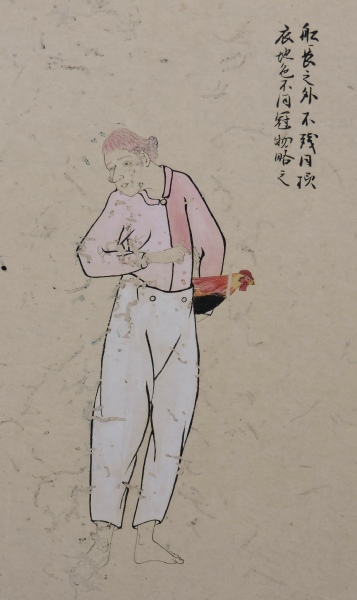
When British ships, including the Saracen, asked to be supplied with pigs (see the second note in the text below) the authorities said they were ‘no common article of food amongst the Japanese’. Consequently, the ones painted (see the thumbnail next to the note) may have been bred by a comprador. This applied to fowls and ducks too. They would have been even less common after the arrival of the sailor. How the angelic Jack Tar acquired the fowl is unclear, but the bird looks none too pleased about where it is going.
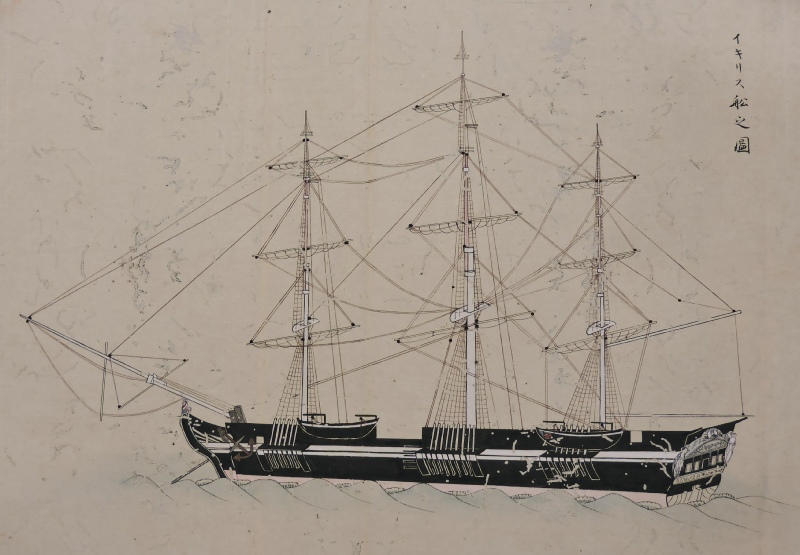
A number of pictures related to the Saracen were painted by a Japanese artist whilst the ship was in the vicinity of Nagasaki. The ship itself is shown above. A rather intimidating figurehead is shown, as is the stern where the words Saracen and London appear. Click on the thumbnails below to see these details.