In October 1852 the Duke of Wellington died. Although he had wanted to be buried at Walmer Castle, near Dover, where he had lived in the last years of his life Queen Victoria insisted he be given a state funeral in London. After his embalmed body had been brought to the Royal Hospital Chelsea it lay in state for five days, allowing members of the public to pay their respects. It is estimated half a million did so. Many of those who queued for entry would also have lined the streets to observe the two mile long procession that accompanied the huge funeral car which took the Duke’s coffin to the final resting place in St Paul’s Cathedral.
Perhaps Charles Hancock joined the crowd of a million and a half on the pavements. He had, after all, been of school age in the year of Waterloo and would probably have carried the idea of the old Duke as a great military hero throughout his life. Nonetheless, as Hancock was a Dissenter and belonged to an emerging middle class that resented a lack of representation in Parliament, he was more likely to have been inclined to sympathise with the liberal policies of the Whigs rather than those of the more conservative Tories. Wellington, who became very powerful politically, was a Tory firmly against reforms that would extend the franchise in England and it was his resistance to change which may have earned him the soubriquet ‘Iron Duke’. Tension rose in the early 1830s as the House of Lords resisted what was to become known as the Great Reform Act but it was Wellington who, as a Prime Minister unable to form a government, advised Tory peers to abstain from a crucial vote. A sufficient number of aristocrats followed his advice to allow the Act to become law.
Although the Great Reform Act did not go as far as many had hoped the two decades following its passage saw a move towards more liberal economic policies even when the Tories were in power. Free trade and the abandonment of tariffs were the order of the day, one example being the repeal of the Corn Laws in 1846. Obviously the England of 1852 did not have the kind of parliament Wellington would have wanted but even political enemies watching the funeral procession would have been reminded that he had been the greatest soldier of his day. Led by a groom, one of the Duke’s horses carried his boots reversed.
As the crowds dispersed London’s commercial and social activity began again and travellers were able to resume their exploration of the city. Most of those who took part in, or watched, the state funeral would have been English, but a visitor recently arrived from St Petersburg came up to the capital from Portsmouth and the notes he made were eventually used in compiling what was probably the most popular Russian travel book of the C19th. It was called The Frigate Pallada. Although rather detached about the death of the Duke, the author, Ivan Goncharov, was certainly impressed with certain aspects of London life beginning with his account of arrival in one of the carriages pulled by a steam locomotive. He said he would never forget how the train burst, at roof top height, into a city he compared to a glittering ocean lit by flaring gas lights. This was just the beginning of what was clearly an intriguing few days. Goncharov enjoyed looking in shop windows where, unusual in his experience, goods were displayed along side their prices and noted how fast the home delivery services were. He was pleased he was able to visit a zoo for only a shilling and although making sure he went to major sights on any tourist itinerary, such as the National Gallery, he was sometimes content just to stand at a crossroads and watch the busy capital world go by. He did want to see the Thames but on making a visit found he could make nothing out because of impenetrable fog. The same thing occurred on a second attempt until a breath of wind blew and the river appeared in all his unsightly finery, lined with brick buildings and choking with ships. What life and activity, he wrote, seethe in this wave-ridden street, directed by the wand of Mercury! One thing that really fascinated Goncharov were the opportunities he saw on his perambulations for the acquisition of knowledge These were often at a very low cost or even free. As he wandered around he noted there were many buildings open to the public where it was possible to view an interesting machine or curio or hear a lecture on natural history.
The writer would not return to St Petersburg directly for he was actually employed on a naval expedition. Officially this was due to circumnavigate the globe but secretly the objective was to ensure Russia was not excluded from the ‘opening up’ of Japan, a move being spearheaded by the United States. Unfortunately, one of the expedition’s vessels, the Pallada, was not really seaworthy enough for a long voyage and had to stop for repairs in Portsmouth. During the time these were being undertaken the expedition’s commanding officer, Admiral Putiatin, who had arrived in England before the frigate, was on his own shopping spree. He purchased a steam schooner, a number of cannon, five dozen carbines and assorted items that could be given as presents to Japanese officials.
Completing the voyage from St Petersburg to the Sea of Okhosk, around which some of the farthest flung Russian territories lay, would take several months via either the Cape of Good Hope or Cape Horn. Even sending a message overland by courier to those areas would have taken several weeks but 1852 proved something of a turning point for the development of the telegraphic infrastructure in Russia, considerable credit laying with Werner Siemens who had made the first contacts with the Tsar’s government in 1849.
Despite the recent opening of a fine rail line between St Petersburg and Moscow the difficulties Siemens found in travelling to St Petersburg were considerable. There was no line between Riga, where his firm was undertaking a telegraphic installation, and the Russian capital so he had to travel in the passenger compartment of a horse drawn sledge. A dry, keen north-east wind kept the January temperatures touching 18C below, which added to his tribulations. At one point Siemens had to stop the sledge by smashing a compartment window, grabbing the driver, who was dead drunk, and throwing him out of his seat. However, after arrival at his destination things quietened down and Siemens seems to have been as impressed with St Petersburg as Goncharov would be with London. Here were broad streets and wide squares and ‘a peculiar mixture of large palaces with small houses, for the most part entirely built of wood’. Sledges replaced carriages in the winter streets, which was strange enough, but the thing Siemens found most disconcerting, as he did not know the Cyrillic script, was an inability to decipher any of the inscriptions on street corners and shops. This, he said, gave him a feeling of forlornness and dependence which he found hard to shake off. Nonetheless, the winter trip proved very worthwhile. He found the majority of positions in the higher echelons of the Russian government filled by Germans from the Baltic States which helped pave the way for obtaining a contract for another telegraph line. This was to run between St Petersburg and a palace on the Gulf of Finland with a connection to the naval base of Kronstadt. More engagement followed. Russia had an extensive and efficient semaphore telegraph system but once it was decided to develop the electric telegraph and Siemens and Halske had accepted the contract installation was done at pace. A line between Moscow and Kiev began operating in 1854 and by June of 1855 this had been extended to Odessa.
None of the developments of 1852 were secret. Perhaps Charles Hancock, fretting about the time it was taking to prepare the arbitration judgement over the division of licence fees for the wire coating machine, wondered if there was any chance of profitable opportunities for the Gutta Percha Company in Russia. Given the prior involvement of Werner Siemens he would have recognised this was very much an outside chance but 1852 had not proved a very successful year for the Wharf Road enterprise as far as submarine telegraphy was concerned. Great Britain remained unconnected with Ireland despite the considerable expense of two failed attempts. There had, however, been a promising development in respect of the production of coated wire for use by the East India Company as a result of the enthusiasm of a Dr Shaughnessy, an employee in the medical department.
As Dr Montgomerie had seen the potential of gutta percha ten years previously so Dr Shaughnessy saw the benefits the electric telegraph might offer to the East India Company, particularly as the first passenger railway link in India was on the point of being inaugurated. Dr Shaughnessy anticipated telegraph lines would be installed alongside railway tracks but thought they could run across country too. However, experiments showed challenges that did not exist in England would have to be addressed if this method of speedy communication was to be rolled out in the sub-continent. It was noted, for example, that after overhead telegraph lines had been installed flocks of heavy adjutant birds began to perch on them, sometimes breaking the wire. Much stronger wires than those used in Britain were clearly needed and the poles that carried them would have to be taller too because, although it was unknown for loaded elephants to be found wandering about in England, this was not the case in India. In places where it might be better for wires to be buried underground there would clearly be a need for insulation and further protection. Consequently, gutta percha insulated wire were laid in wooden sleepers well saturated in arsenic to prevent attack by white ants.
After the Governor General of India, the Earl of Dalhousie, was persuaded by the doctor’s telegraphic proposals he recommended them to the East India Company’s Court of Directors, based in London. Dr Shaughnessy was then asked to come to England and make preparations for acquiring and shipping the materials needed to lay the basis of an electric telegraph infrastructure. A few months after he arrived a meeting was arranged at Warley, near Brentwood, which was where the company maintained a depot. Here a number of experts in various telegraphic fields were invited to give demonstrations of their own proposals for elements in the system that had yet to be finalised. One person who attended was Mr Statham the energetic manager of the Gutta Percha Company who seemed to combine his official role with that of technical advisor and travelling salesman. There was really no competition as far as the insulation of underground telegraph wire was concerned but Mr Statham took the opportunity to show how valuable a gutta percha coated wire could be in military matters. Over five miles of insulated wire were laid out in an open area before one end was attached to a loaded cannon. An instantaneous detonation occurred when wires and a battery were connected at the other.
The material collected by Dr Shaughnessy was eventually shipped out to India partly on the same route that the Pallada would follow on its way to Japan. Admiral Putiatin’s original intention had been for the expedition to sail into the Pacific via Cape Horn but because of the delay caused by the need for hull repairs it was too late to the catch favourable winds. Consequently, it was decided to proceed via the Cape of Good Hope instead, this being the route H.M.S. Saracen would also take when, in the following year, she left on a survey voyage that would also take her to Japan. Once sailing along the coast of Africa all ships bound for the Indian Ocean and beyond left the world served by the electric telegraph behind. However, although they may have never met nor seen them, many ships travelling in the opposite direction would have been transporting blocks of solidified gum to Europe. Many blocks would find their way to Wharf Road where they would be converted into core insulation in the submarine telegraph cables that would eventually enormously reduce the time taken to send a message to the most distant parts of Queen Victoria’s empire. 1853 was to set a new record for gutta percha exports from Singapore. The shipping weight was 13,858 cwt. In 1844 it had been just 2.
Supplying insulated wire that could survive the attack of white ants to the East India Company might, eventually, prove a money spinner for the Wharf Road manufacturer as could the use of the same type of wire as a fuse. However, it was clear the production of submarine telegraph cable nearer home currently offered the best prospects of profitability and in April 1853 a new armoured submarine cable was prepared for loading on the William Hutt, a vessel chartered for cable laying work between Dover and Ostend. Unfortunately for Hancock, three days before loading began his hopes of obtaining the maximum personal profit from his coating machine patent were dashed. When the arbitration decision was announced he was told it had been decided a fair division, which was in line with previous agreements, meant he should have exactly the same proportion of the patent licence profits as Bewley. As this was only a quarter and Hancock wanted everything he rejected the finding and determined to take matters further, expensive though this would be.
As Hancock nursed his wounds the William Hutt laid the cable between England and Belgium and on May 6th a direct message was sent between the two countries. The celebrations around this success had hardly died away before another armoured cable with a gutta percha core reached the final stage of manufacture. It was to be approximately 130 miles long and laid from the coast of Suffolk to the coast of Holland. The company behind this project had purchased a vessel, the Monarch, specifically for the laying work. She was a wooden paddle steamer that had already seen over 20 years service trading between Hull and Hamburg but once fitted out as a cable layer was ready to start work at the end of May. It was not unusual for those closely involved in production of a submarine cable to be invited go along to observe as it was reeled out into the sea. For such an important project it is not surprising Robert Newall wanted to go even though his company, R.S.Newall, had actually subcontracted the armouring work to another firm due to having a full order book. The representative of the Gutta Percha Company would, as might be expected, be Samuel Statham. As the final preparations were put in place at Orfordness, a little fleet comprising of the cable laying Monarch, the steam tug Goliath, hired in case the Monarch needed assistance, and H.M.S. Adder, which was provided by the Admiralty to act as a pilot, made ready to sail. Timing of the start of the work was all important but as the hours and minutes passed there was no sign of either Newall or Statham. So, as time and tide wait for no man, the order was given to leave without them. Quite why the two men missed the departure, which took place at 9am on Monday, May 30th, is unclear but in any event by the time they arrived the Monarch, Goliath and Adder were gone and there was no trace of them on the horizon. In fact the ships were now 30 miles away but contact was being maintained through the cable that was being laid and a short telegraphic conversation between ship and shore then took place. Afterwards there would have been no practical alternative for Newall and Statham but to return to London.
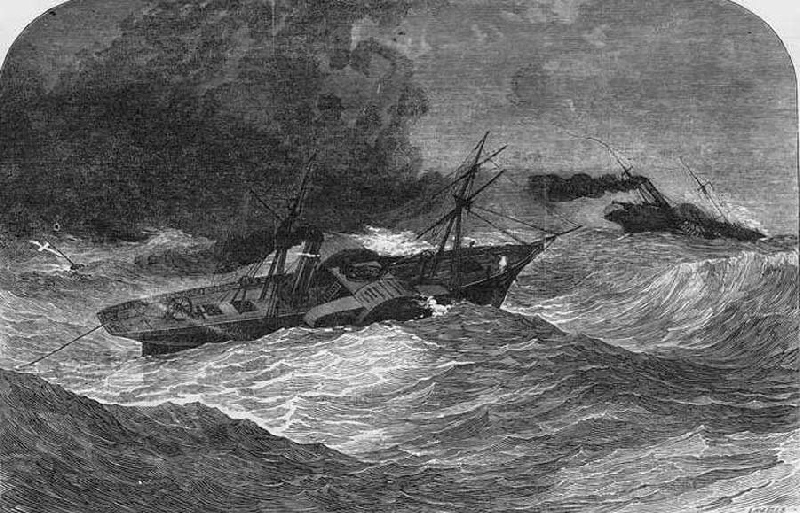
The failure to depart with the cable laying convoy would certainly have been disappointing for Statham and Newall but at least there was the possibility of a celebration if the cable was laid successfully to the Dutch port of Scheveningen, where the landing was to be made. Although the weather on the Suffolk coast remained good the expedition ran into stormy weather in the North Sea and there were concerns about both the stability of the funnel and the cable laying brake device on the Monarch. However, immediate attention ensured both were secured and although the operator of the cable brake was also in some peril he had himself lashed to his post so the operation continued as planned. After the Goliath turned for home the Monarch followed the line set by buoys dropped from the Adder and eventually the Dutch coast was reached, the two ships arriving at the exact landing point the day after leaving Orfordness. However, it was another two days before the end of the cable could be brought ashore and then for the first time, on Thursday, June 3rd, messages could be passed directly by telegraph between Holland and England. No doubt celebrations took place at Wharf Road when the news came through. As the cable was being laid it had been tested every thirty seconds and the core was not found wanting. Another job well done.

When London Became An Island
Gutta Percha comes to the Metropolis
Chapter 15 - An arbiter’s decision
Commanders and clippers

Boots reversed
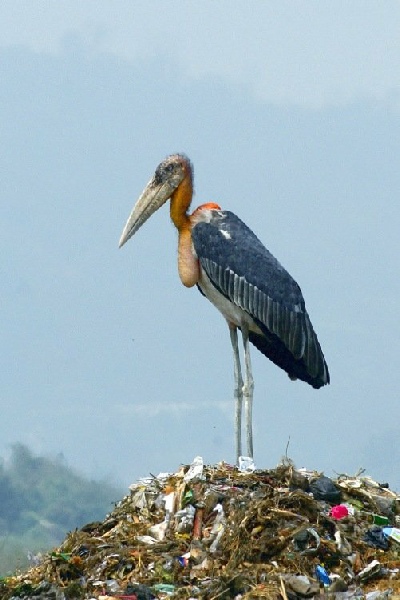
Too heavy for telegraph wires
The Monarch follows the Adder